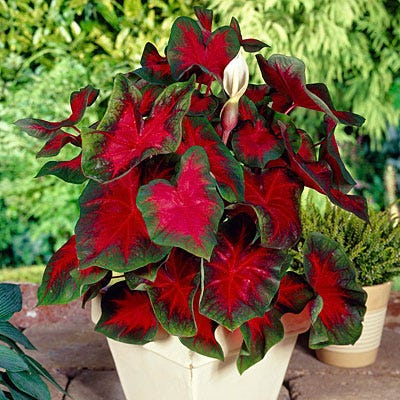
Florida Cardinal Caladium
Growing Caladiums: Caladiums are beautiful natives of the South American Rain Forests. With their brilliant colors in fascinating designs, and large heart-shaped leaves, they've become landscape favorites, especially since they are perfect for shaded areas. They're very easy to grow, but you must take care and remember that they are tropical. This means you can't plant your tubers until the ground has warmed up in spring. In the south, that means May. In the midwest and north, it means from mid-May until mid-June. Planting in cold soil will stunt your Caladiums, and you don't want to do that.
Great for pots. The cold-sensitivity of Caladiums is why they've become big favorites for pots, baskets, and patio planters. If you start them indoors, you can simply put the pots outside once your weather is warm. And in fall, the pots make everything simple. Once your first cold snap wilts the leaves in fall, simply bring you pots inside, let the tops die down, and keep them as they are (in a non-freezing area) until spring, and put them out again. This is how many northern gardeners grow these beauties.
Spectacular Ground Cover: Many gardeners use these colorful plants as a ground cover for shady areas. (Who says you can't have great color in the shade!) Caladiums around trees or in other shady areas have long been beautiful features of southern gardens, but this technique can work anywhere, as long as you don't put out your plants until your soil is good and warm.
Starting your tubers: Plant your tubers with the 'eyes' upward--one tuber to a 4" pot, and 3 tubers in a gallon-size. Use about 1 1/2" of soil over the tubers. Keep them evenly moist and very warm after planting. (Like amaryllis in fall, bottom heat helps sprout these tropical tubers...if you have a warm radiator, try putting your pots there until they're well-sprouted.) Once they're up, liquid fertilizer helps; they respond much like African violets and tuberous begonias to regular feedings.
Florida Cardinal Caladium
Growing Caladiums: Caladiums are beautiful natives of the South American Rain Forests. With their brilliant colors in fascinating designs, and large heart-shaped leaves, they've become landscape favorites, especially since they are perfect for shaded areas. They're very easy to grow, but you must take care and remember that they are tropical. This means you can't plant your tubers until the ground has warmed up in spring. In the south, that means May. In the midwest and north, it means from mid-May until mid-June. Planting in cold soil will stunt your Caladiums, and you don't want to do that.
Great for pots. The cold-sensitivity of Caladiums is why they've become big favorites for pots, baskets, and patio planters. If you start them indoors, you can simply put the pots outside once your weather is warm. And in fall, the pots make everything simple. Once your first cold snap wilts the leaves in fall, simply bring you pots inside, let the tops die down, and keep them as they are (in a non-freezing area) until spring, and put them out again. This is how many northern gardeners grow these beauties.
Spectacular Ground Cover: Many gardeners use these colorful plants as a ground cover for shady areas. (Who says you can't have great color in the shade!) Caladiums around trees or in other shady areas have long been beautiful features of southern gardens, but this technique can work anywhere, as long as you don't put out your plants until your soil is good and warm.
Starting your tubers: Plant your tubers with the 'eyes' upward--one tuber to a 4" pot, and 3 tubers in a gallon-size. Use about 1 1/2" of soil over the tubers. Keep them evenly moist and very warm after planting. (Like amaryllis in fall, bottom heat helps sprout these tropical tubers...if you have a warm radiator, try putting your pots there until they're well-sprouted.) Once they're up, liquid fertilizer helps; they respond much like African violets and tuberous begonias to regular feedings.
Product Information
Product Information
Shipping & Returns
Shipping & Returns
Description
Growing Caladiums: Caladiums are beautiful natives of the South American Rain Forests. With their brilliant colors in fascinating designs, and large heart-shaped leaves, they've become landscape favorites, especially since they are perfect for shaded areas. They're very easy to grow, but you must take care and remember that they are tropical. This means you can't plant your tubers until the ground has warmed up in spring. In the south, that means May. In the midwest and north, it means from mid-May until mid-June. Planting in cold soil will stunt your Caladiums, and you don't want to do that.
Great for pots. The cold-sensitivity of Caladiums is why they've become big favorites for pots, baskets, and patio planters. If you start them indoors, you can simply put the pots outside once your weather is warm. And in fall, the pots make everything simple. Once your first cold snap wilts the leaves in fall, simply bring you pots inside, let the tops die down, and keep them as they are (in a non-freezing area) until spring, and put them out again. This is how many northern gardeners grow these beauties.
Spectacular Ground Cover: Many gardeners use these colorful plants as a ground cover for shady areas. (Who says you can't have great color in the shade!) Caladiums around trees or in other shady areas have long been beautiful features of southern gardens, but this technique can work anywhere, as long as you don't put out your plants until your soil is good and warm.
Starting your tubers: Plant your tubers with the 'eyes' upward--one tuber to a 4" pot, and 3 tubers in a gallon-size. Use about 1 1/2" of soil over the tubers. Keep them evenly moist and very warm after planting. (Like amaryllis in fall, bottom heat helps sprout these tropical tubers...if you have a warm radiator, try putting your pots there until they're well-sprouted.) Once they're up, liquid fertilizer helps; they respond much like African violets and tuberous begonias to regular feedings.