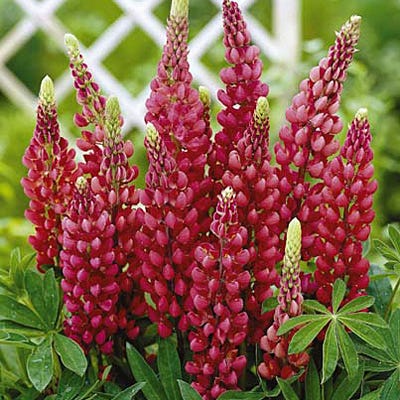
Gallery Red Lupine
But when it comes to hybrids, there is really only one group--the world-famous Russell Lupines. They were created by crossing several lupine species, most notably blue L. polyphyllus, a native of the Pacific Northwest. By careful hybridization and years of work, a man named George Russell in England perfected the multicolored strains in 1937, and they've been the standards ever since.
The Gallery Hybrids are considered a dwarf form, since many lupines are very tall plants. Gallery Hybrids grow to only about 18 in an endless array of colors and bi-colors.
Growing Lupines These prized plants are not hard to grow, and in fact, many of the wild species are permanent features in wildflower meadows. (See our Individual Species List for seeds of several native species including Texas Bluebonnet.)
The Russell Hybrids are a bit more fussy. They are best where soils are rich and conditions are cool. In zones 4 and 5 they are fine, but considered a short-lived perennial, even in New England. From Zone 6 south, they grow beautifully, but are hard to preserve and should be planted as annuals.
One of my favorite perennial author/experts, Alan Armitage, says, Flowers more perfect than those of the lupine hybrids are difficult to imagine.
More Images
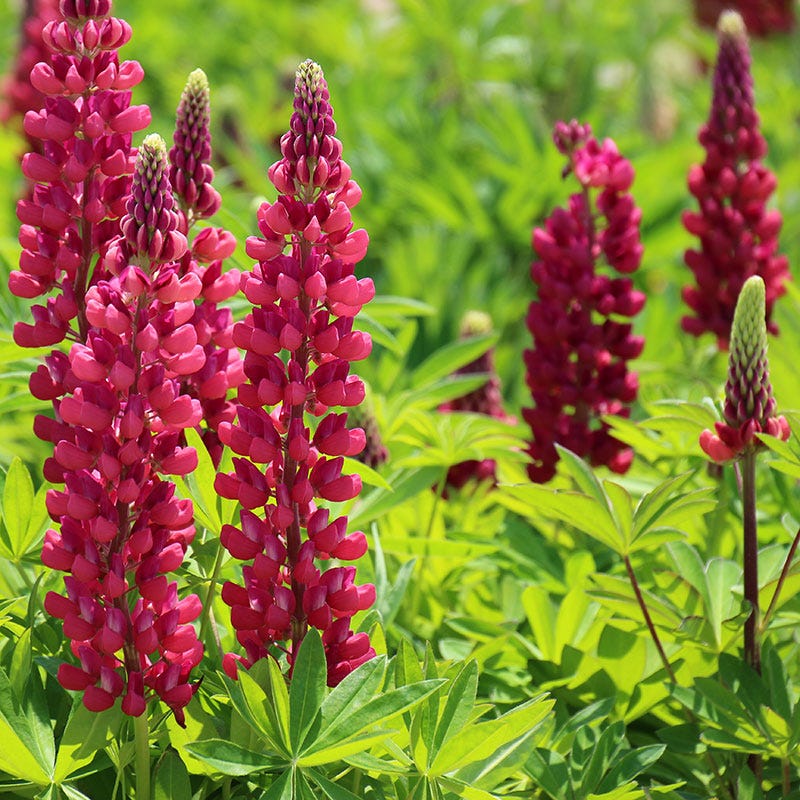
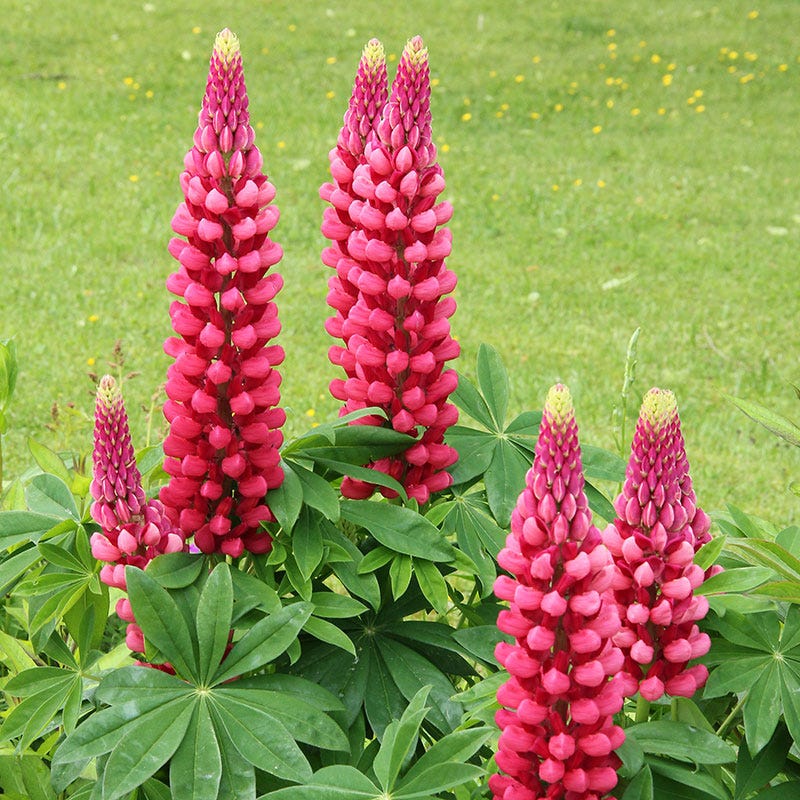
Gallery Red Lupine
But when it comes to hybrids, there is really only one group--the world-famous Russell Lupines. They were created by crossing several lupine species, most notably blue L. polyphyllus, a native of the Pacific Northwest. By careful hybridization and years of work, a man named George Russell in England perfected the multicolored strains in 1937, and they've been the standards ever since.
The Gallery Hybrids are considered a dwarf form, since many lupines are very tall plants. Gallery Hybrids grow to only about 18 in an endless array of colors and bi-colors.
Growing Lupines These prized plants are not hard to grow, and in fact, many of the wild species are permanent features in wildflower meadows. (See our Individual Species List for seeds of several native species including Texas Bluebonnet.)
The Russell Hybrids are a bit more fussy. They are best where soils are rich and conditions are cool. In zones 4 and 5 they are fine, but considered a short-lived perennial, even in New England. From Zone 6 south, they grow beautifully, but are hard to preserve and should be planted as annuals.
One of my favorite perennial author/experts, Alan Armitage, says, Flowers more perfect than those of the lupine hybrids are difficult to imagine.
Product Information
Product Information
Shipping & Returns
Shipping & Returns
Description
But when it comes to hybrids, there is really only one group--the world-famous Russell Lupines. They were created by crossing several lupine species, most notably blue L. polyphyllus, a native of the Pacific Northwest. By careful hybridization and years of work, a man named George Russell in England perfected the multicolored strains in 1937, and they've been the standards ever since.
The Gallery Hybrids are considered a dwarf form, since many lupines are very tall plants. Gallery Hybrids grow to only about 18 in an endless array of colors and bi-colors.
Growing Lupines These prized plants are not hard to grow, and in fact, many of the wild species are permanent features in wildflower meadows. (See our Individual Species List for seeds of several native species including Texas Bluebonnet.)
The Russell Hybrids are a bit more fussy. They are best where soils are rich and conditions are cool. In zones 4 and 5 they are fine, but considered a short-lived perennial, even in New England. From Zone 6 south, they grow beautifully, but are hard to preserve and should be planted as annuals.
One of my favorite perennial author/experts, Alan Armitage, says, Flowers more perfect than those of the lupine hybrids are difficult to imagine.